XMCA Research Paper Archive
Spring 2013
Vygotsky's Theory of Creativity: On Figurative and Literal Thinking
Larry Smolucha & Francine SmoluchaFall 2012
"Minding the Gap": Imagination, Creativity, and Human Cognition
Etienne Pelaprat & Michael ColeWorking With Cultural-Historical Activity Theory and Critical Realism to Investigate and Expand Farmer Learning in Southern Africa
Mutizwa Mukute & Heila Lotz-SisitkaGerminated Seeds: The Development of Vygotsky's Psychology of Art in His Early Journalistic Publications
Bella Kotik-FriedgutDiscursive Construction of "Good Teaching:" A Crossdisciplinary Framework
David KirshnerFall 2011
The Path to Subjectivity: Advancing Alternative Understandings of Vygotsky and of the Cultural Historical Legacy
Fernando Gonzalez Rey_Portes & Salas, 2011Summer 2011
Vygotsky, Bakhtin, Goethe: Consciousness as Con-Scientia, as Witnessable Knowing Along with Others
John Shotter
Winter 2011
Call for Papers: Special issue on "Psychology of Emotions and Cultural Historical Activity Theory"
Call for Papers: Special issue on "Concept Formation in the Wild"
Fall 2010
Forgotten Methodology: Vygotsky's Case
Nikolai VeresovSociety versus Context in Individual Development Does Theory Make a Difference?
Charles W. TolmanThe Real Ideal: An illustrated guide to Vygotsky's Psychology of Art
David Kellogg
Fall 2009
An interdisciplinary concept of activity
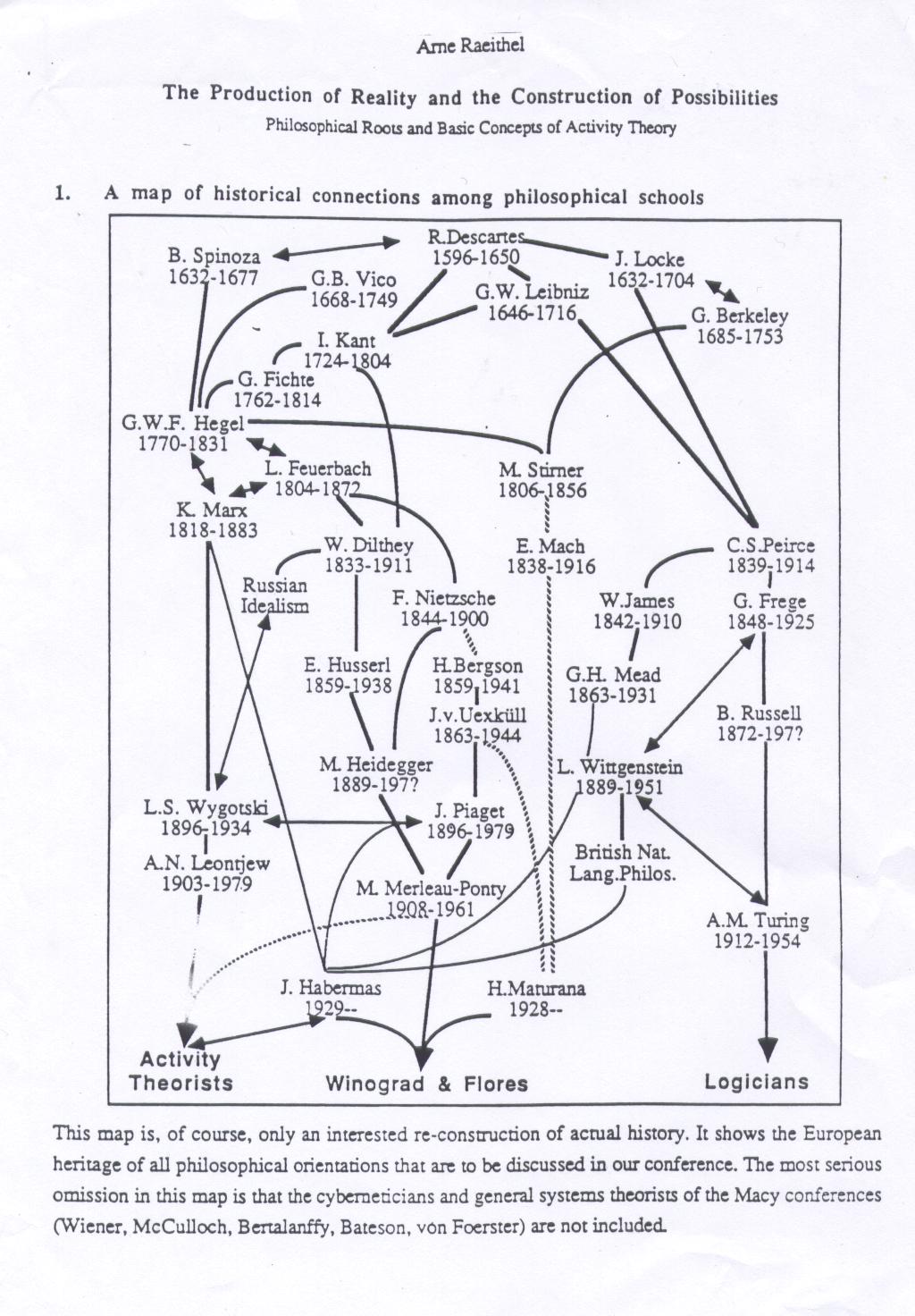
Andy BlundenGenealogy of Cultural-Historical Activity Theory (diagram)
Andy Blunden
Winter 2009
Vygotsky’s plural discourse on the human mind
Jussi Silvonen
Fall 2008
Race and Language as Capital in School: A Sociological Template for Language Education Reform
Allan LukeThe Future of Activity Theory: A Rough Draft
Yrjö Engeström, University of HelsinkiCHAT and HIV/AIDS: An activity system analysis of a lack of behaviour change
Mary van der RietActivity Theory and reconceptualising HIV/AIDS interventions
Mary van der Riet
Summer 2008
The Role of Development Concepts in the History of Gestalt Theory: The Work of Kurt Koffka
Mitchell G. AshVygotsky and Lenin on Learning: The Parallel Structures of Individual and Social Development
Wayne AuRace, culture and identities in second language education.
Allan Luke, Queensland University of Technology (2008)
Spring 2008
Understanding Innovation: An evolutionary social learning model
Geoffrey Binder, School of Global Studies, Social Science and Planning, RMITHuman Development as semiotic-material Ordering: Sketching a Relational Developmental Psychology
Michalis Kontopodis (Humboldt University of Berlin)Creativity in the Making: Vygotsky’s Contemporary Contribution to the Dialectic of Creativity & Development
Seana Moran and Vera John-Steiner
Winter 2008
Problems of the Method of Cultural-Historical Psychology, 2006
F.T. MIKHAILOVStetsenko and Arievitch: Vygotskian Project for Social Transformation
Anna Stetsenko and Igor M. Arievitch
Spring 2007
Against Narrativity
Galen Strawson, 2004Lev S. Vygotsky: The Man and the Era
Uwe P. Gielen, Samvel S, Jeshmaridian - TSHC, 1999To Create Psychology's OTSHC wn Capital
Mohamed Elhammoumi, TSHC
Winter 2007
Chapters 3 & 4 of The Sociocultural – Semiotic Texts of Five and Six Year Old Emergent Biliterates in non-academic settings
M. Cathrene Connery, 2006Looking at Action Research through the Lenses of Sociocultural Psychology and Activity Theory
Anne Edwards (Edwards 2000), University of Birmingham U.K.Pensamiento y Palabra
Volumen XCIV de la Colección Aprendizaje dirigida por Amelia Alvarez Pablo del Rio. Titulo original: Sobrania Sochinenii Tom vtoroi, Problemi obshei psijologuii
Fall 2006
Vygotsky`s Social Constructionist View on Disability: A Methodology for Inclusive Education
Katarina A. Rodina, PhD-Research Fellow, MSc. Speech and Language Pathology, Department of Special Needs Education, University of Oslo,
Citation: Rodina, K. (2006). "Vygotsky's Social Constructionist View on Disability: A Methodology for Inclusive Education." In Lassen, L. (Ed.).
Enabling Lifelong Learning in Education, Training and Development: European Learning Styles Information Nettwork (ELSIN),
University of Oslo: Oslo, CD/ISDN 82-8075-020-7
(IMATRA Paper) The Overwhelming World: Functions of pleromatization in creating diversityin cultural and natural constructions
Jaan Valsiner, Department of Psychology, Clark UniversityProblems of General Psychology
from "The Collected Works of L.S. Vygotsky", edited by Robert W. Rieber
Spring 2006
Communicative Practice, Cultural Production, and Situated Learning
Video Conference
Kevin O'ConnorThe Social Environment of the Classroom: a Vigotskian Perspective on Small Group Process
by Peter Smagorinsky and Pamela K. Fly
Winter 2006
Developing a Psychology that Builds Community and Respects Diversity
Lois Holzman and Shelley KarlinerRace, Identity and Epistemology
by Lenora FulaniGenealogy of Ideas
Arne RaeithelCreativity in the Making: Vygotsky's Contemporary Contribution to the Dialectic of Development and Creativity
Seana Moran and Vera John-Steiner
Fall 2005
On the Problem of the Psychology of the Actor's Creative Work
Vygotsky L.S.Race, Identity and Epistemology
Lenora FulaniDeveloping a Psychology that Builds Community and Respects Diversity
Lois Holzman and Shelley Karliner, East Side Institute for Group and Short Term PsychotherapyVisual Salience of Algebraic Transformations
David Kirshner, Louisiana State University, Thomas Awtry, Louisiana State University, Alexandria, Journal for Research in Mathematics Education , 35(4), 224-257, July 2004
June/July 2005
Minicourse
June 13 - 19: facilitated by Steven Thorne and Phil Chappell A Preliminary Reading on Tools and Signs
Vygotsky, L. S. (1997). The Collected works of L.S. Vygotsky Volume 4: The History of the Development of Higher Mental Functions. New York; London: Plenum Press, pp 54; 59-63
" Tool and Sign in the Development of the Child " Anna Stetsenko, City University of New YorkActivity and Additional Language Learning: the Russian Perspective and a " Linguistics of Communicative Activity "
Leontiev, A.A. (1981). Speech and Communication, in Psychology and the Language Learning Process . Oxford: Pergamon, pp 21-28
Lantolf, J., & Thorne, S.L. (in press) Introduction, in Sociocultural Theory and the Genesis of Second Language Development . New York, NY: Oxford University Press.June 20 - July 26: facilitated by Gordon Wells Meaning Making in Educational Activity: Vygotsky and Halliday
Halliday, M. A. K. (1993). Towards a language-based theory of learning. Linguistics and Education , 5(2), 93-116.
Wells (1999). The complementary contributions of Halliday and Vygotsky to a 'language-based theory of learning'. In Dialogic Inquiry: Toward a Sociocultural Practice and Theory of Education (pp. 3-50). New York, NY: Cambridge University Press.June 27 - July 3: facilitated by Harry Daniels with Ruqaiya Hasan
Mediating, Mediator, Mediatee and the Mediated: Unpacking Semiotic Mediation
Hasan R. (manuscript) Semiotic mediation, language and society: three exotropic theories -Vygotsky, Halliday and Bernstein
Hasan, R. (2002). Semiotic Mediation and Mental Development in Pluralistic Societies: Some Implications for Tomorrow's Schooling. In Learning for life in the 21st century: sociocultural perspectives on the future of education (pp. 112-26). Malden, MA: Blackwell Publishers.July 3: Further Reading
Bernstein, B. (1999). Vertical and Horizontal Discourse: an essay. British Journal of Sociology of Education, 20(2), 157-74.
Marjanovic-Shane, A. Components of Metaphoric Proposition Chapter 4.Concrete Human Psychology: an unpublished manuscript L.S. Vygotsky
Other suggested readings and discussions
Spring 2005
On Phenomenology and Social Relations Alfred Schutz
"Chapter 3: Vygotsky and the cultural historical theory" - the chapter is from Gunilla Lindqvist's dissertation: Lindqvist, G. (1995). The aesthetics of play: A didactic study of play and culture in preschools. Geteborg: Coronet Books. by Lindqvist, Gunilla -- from her 1995 book, The Aesthetics of Play: A Didactic Study of Play and Culture in Preschools.<http://lchc.ucsd.edu/MCA/Paper/VygotskyOnPlay.pdf> - PDF
Elkonin - PDF
Winter 2005
Concrete Human Psychology (Print page to read small print)
PDF option - 17.2 MB
L.S Vygotsky
Summer 2004
Psychological Conditions of the Origin of Ideal Acts
V.V. Davydov and V.P. Andronov
Spring 2004
Ch. 5: The Institutional Level of Regulation and Analysis
by Harry Daniels (Paper formatted in PDF)The Relations of Learning and Student Social Class: Toward Re-"Socializing" Sociocultural Learning Theory
by Carolyn P. Panofsky (Paper formatted in PDF)Script, Counterscript, and Underlife in the Classroom: James Brown versus Brown v. Board of Education .
by Kris Gutierrez, Betsy Rymes, University od California, Los Angeles
Joanne Larson, University of Rochester
Fall 2002
Estranged Learning
by Jean Lave and Ray McDermott (Paper formatted in PDF)
Spring 2002
Studying the workplace: considering the usefulness of activity theory,
by Helena WorthenEmergence in Psychology: Lessons from the History of Non-Reductionist Science
by R. Keith SawyerUnresolved Tensions in Sociocultural Theory: Analogies with Contemporary Sociological Debates
by R. Keith SawyerUntangling Teachers Diverse Aspirations For Student Learning:
A Crossdisciplinary Strategy for Relating Psychological Theory to Pedagogical Practice
by David Kirshner
Winter 2002
A video interview with Yrjo Engestroom
Recorded 16th January 2002, at CSALT, Lancaster University, UK.Participation as Dis-Identification With/in a Community of Practice
by Diane Hodges
*The final version of this article can be found in Volume 5, Number 4 of the XMCA Journal
Fall 2001
The role of academic community in higher learning: Alternatives to a drive-thru education,
Naomi Sunderland and Phil GrahamThe Historical Meaning of the Crisis in Psychology: A Methodological Investigation,
LS Vygotsky, 1927
Summer 2001
The Falling Scholar Essays in the Outside
Dr. Diane Celia Hodges
Spring 2001 Discussion
Learning by Expanding , Yrjö Engeström.
During the months of April and May 2001 we had a unique opportunity to discuss the work of Yrjö Engeström. This reading corresponded with his visit to the UCSD.
Winter 2000/01 Discussion Papers
From the Transmission of Representations to the Education of Attention
Tim IngoldThree in One: On Dissolving the Distinctions Between Body, Mind, and Culture
Tim IngoldAre We Ready for a Single, Integrated Theory?,
By Michele Minnis and Vera P. John-SteinerEssay review of Perspectives on Activity Theory, Edited by Yrjö Engeström, Reijo Miettinen, and Raija-Leena Punamäki
Agency and Culture
Carl RatnerThis article analyzes two viewpoints concerning the relation of agency and culture. One viewpoint construes agency as a personal trait that operates outside of culture and is designed to liberate the individual from cultural constraints. I explore this viewpoint in the work of several eminent cultural psychologists. I critique it as a regression to asocial individualism which cultural psychology was designed to correct. I propose an alternative conception of agency as a cultural phenomenon. Espoused by Durkheim, Marx, Boas, and Bhaskar, this conception holds that agency depends upon cultural processes for its realization, forms culture, and has a cultural form. Agency is the active element of culture. Being a cultural phenomenon means that agency is a historical project which must be realized through humanizing society.
Zopeds in the Classroom
Examples of Teaching/Learning Within ZPD
The Zone of Proximal Development in Vygotsky's Analysis of Learning and Instruction
by Seth ChaiklinThe Zone of Proximal Development as Basis for Instruction
Marianne HedegaardBoys & Girls Ch 26
by V. Paley
Quarterly Newsletters (1976-93)
Fall 2000 Leont'ev - Activity, Consciousness, and Personality Discussion
Fall 1999 / Spring 2000 Discussion Papers
You will find most of the papers that were discussed as part of the monthly XCMA collective reading.
Various 1990 Discussion Papers